Plastic Production
Plastics are hard, ductile materials that in the real world have a significant number of usages, from packaging to toys to piping.
In your factory, plastics will be primarily used for electronic components, machinery, multiblock machine casings, and cabling. MSI has multiple types of plastic, each one with its own set of usages.
All plastics are polymers; they are the result of a chemical known as a monomer undergoing polymerisation. For the sake of simplicity, this document will discuss the manufacture of the initial monomers leading to the polymers as well as how to polymerise them into the resulting plastics.
Polyethylene
Polyethylene is the polymer version of ethylene (or ethene), the simplest (and shortest) of the alkenes, and will be the first plastic you will manufacture in bulk. Polyethylene is normally polymerised using metal catalysts (such as titanium(III) chloride, or chromium oxide); due to its position early on in progression, this is ignored in favour of simple exothermic polymerisation using air or oxygen at first.
There are two main ways of getting ethylene; the first is from biological processes via ethanol or glycerol and the second is from oil refining.
Bioethylene
Ethylene can be obtained in abundant quantities via reacting ethanol with sulfuric acid in a dehydration reaction like so:
This uses Sulfuric Acid as a catalyst for the reaction. Ethanol is made from the distillation of biomass which has multiple possible methods of production, in order of efficiency:
Most crops can be directly brewed into biomass, as well as saplings and mushrooms.
Bio Chaff can be directly distilled into biomass; Bio Chaff is made from macerating plant balls, which are made from either compressing crops, centrifuging dirt/grass, or centrifuging rubber logs.
Bio Chaff can be converted into biomass inside a Pyrolyse Oven. This is only recommended after acquiring Ferrochroluminium coils due to the speed penalty of Cupronickel coils.
If you have the Snad mod installed, a sugar cane farm will provide a significant amount of biomass very cheaply and quickly. Alternatively, in the HV tier, Ethylene can be made from Glycerol which is a byproduct of biodiesel production when using seed or fish oils.
The main disadvantage of this method is that it is extremely slow. A single bucket of ethylene takes 60 seconds to produce from Ethanol with no overclocks requiring a large number of Chemical Reactors as an up-front investment.
Oil Cracking
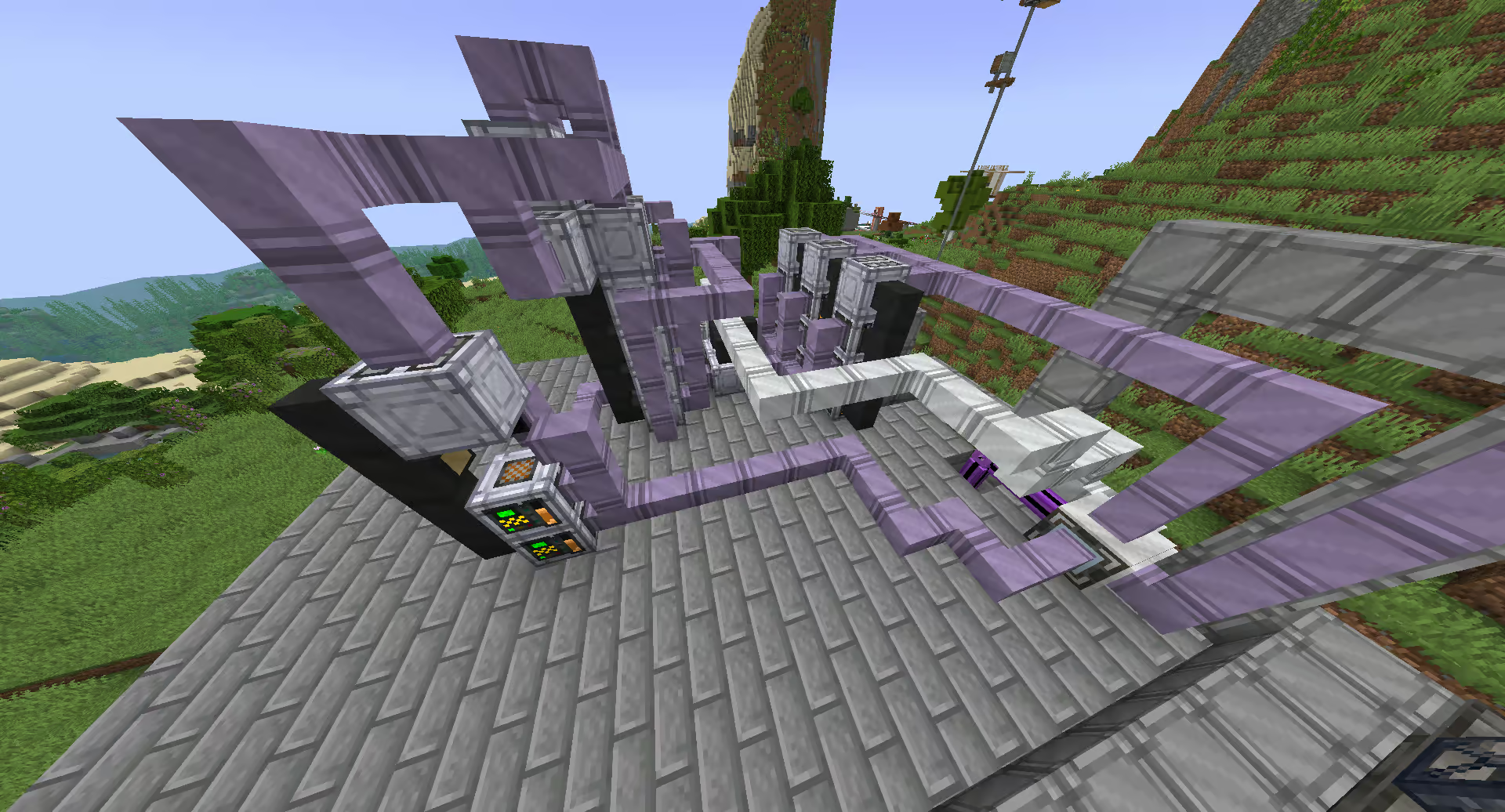
An ethylene production facility that utilises singleblock distilleries.
The otther method for obtaining ethylene is from oil processing. All steam-cracked oil refining intermediates produce some ethylene, but the best direct source of ethylene is from severely steam-cracked naphtha at 500mB per input bucket. This is the easiest source of ethylene if you’re using singleblock distilleries.
On the other hand, if you use a full distillation setup and crack all of the byproducts, the best intermediate available is lightly hydro-cracked naphtha giving 1562.5mB of ethylene per input bucket.
Oil intermediates table
Fuel Type |
Cracking |
Direct Ethylene output |
But(e/a)ne output |
Butadiene Output |
Propane output |
Propene output |
Ethane output |
Total output |
|---|---|---|---|---|---|---|---|---|
Naphtha |
Severe steam |
500 |
75 |
81.25 |
15 |
300 |
16.25 |
987.5mB |
Naphtha |
Light steam |
200 |
120 |
243.75 |
15 |
200 |
8.75 |
787.5mB |
Naphtha |
Severe hydro |
N/A |
187.5 |
N/A |
125.0. |
N/A |
375.0 |
687.5mB |
Naphtha |
Light hydro |
N/A |
1200.0 |
N/A |
300.0 |
N/A |
62.5 |
1562.5mB |
Light Fuel |
Severe steam |
250 |
97.5 |
81.25 |
50 |
250 |
12.5 |
741.25mB |
Light Fuel |
Light steam |
112.50 |
112.5 |
97.5 |
20 |
150 |
2.5 |
432.5mB |
Light Fuel |
Severe hydro |
N/A |
187.5 |
N/A |
125.0 |
N/A |
375 |
687.5mB |
Light Fuel |
Light hydro |
N/A |
225 |
N/A |
200 |
N/A |
31.25 |
456.25mB |
Heavy Fuel |
Severe steam |
150 |
120 |
81.25 |
10.0 |
100 |
3.75 |
465.0mB |
Heavy Fuel |
Light steam |
50 |
37.5 |
24.375 |
3.0 |
30.0 |
1.25 |
146.125mB |
Heavy Fuel |
Severe hydro |
N/A |
450.0 |
N/A |
300 |
N/A |
43.75 |
793.75mB |
Heavy Fuel |
Light hydro |
N/A |
150.0 |
N/A |
100 |
N/A |
18.75 |
268.75mB |
Poly(vinyl chloride)
Poly(vinyl chloride) - more commonly known as PVC - is a plastic mostly used in the real world for construction including pipings, doors, and sidings. In MSI it is used for the insulation of higher-tier cables, as an alternative for basic circuit boards, and as an early set of fast item pipes.
As the name suggests, poly(vinyl chloride) is the polymerised form of the vinyl chloride mononer, and the only usage of vinyl chloride. Vinyl chloride is made from ethylene via 1,2-Dichloroethane:
From there, the vinyl chloride is mechnically polymerised using air or oxygen to get the polymer. See the previous section for how to acquire ethylene, and see Chlorine for how to get the chlorine.
Poly(tetrafluoroethylene)
Poly(tetrafluoroethylene) - more commonly known as PTFE or Teflon - is an inert plastic primarily used as a casing material, both for singleblock machine casings and for multiblocks. It is the polymerised form of the tetrafluoroethylene radical.
There are two ways of making tetrafluoroethylene. The first is via chloroform:
This method can be done in singeblock chemical reactors as soon as you have a source of fluorine. Alternatively, as soon as EV energy hatches are available, this can be done as a single-step process in the Large Chemical Reactor:
Regardless of which method you use for tetrafluoroethylene, it is polymerised using a small amount of sodium persulfate, up to 0.3% for the bulk recipe made inside the Large Chemical Reactor.